





Vol 11, No 1 (2025): SPACES OF LANGUAGE EDUCATION IN THE CIS COUNTRIES
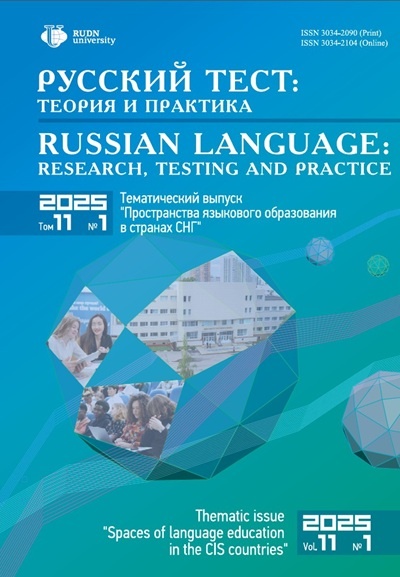
- Year: 2025
- Articles: 8
- URL: https://hlrsjournal.ru/russian-test/issue/view/1996
- DOI: https://doi.org/10.22363/3034-2090-2025-11-1
Full Issue

Testing systems in modern language education
The unified entrance test in Russian for international applicants: a new educational reality
Abstract
One of the objectives of state policy in supporting the Russian Language and the languages of the peoples of the Russian Federation is the implementation of a unified (standardized) entrance examination in Russian for international applicants to Russian higher education institutions. Conducting entrance examinations in Russian for international applicants who have not completed pre-university preparation is an important component of the work of Russian universities, as their primary goal is the high-quality and objective selection of prospective students with a sufficiently high level of Russian Language proficiency. The implementation of a set of measures, including regulatory legal aspects, methodological support, testing, and implementation of the unified entrance examination, will contribute to improving the recruitment and training of international citizens at Russian higher education institutions. A separate aspect of the implementation of the unified entrance examination is the definition of uniform requirements for the level of Russian Language proficiency necessary for mastering higher education programs at Russian educational and scientific institutions. The purpose of this study is to analyze the effectiveness of a unified entrance test in Russian for international applicants in an interview format, based on a study of the development and implementation of assessment materials for interviews at RUDN University. It was demonstrated that the proposed entrance test format contributes to increased objectivity in assessing the entrance exam. The language assessment materials implements equal requirements for Russian Language proficiency for foreign students in preparatory faculties (departments) of the Russian Federation and for international applicants. This is also confirmed by the experience of using interviews in the Russian Language educational environment of the Republic of Belarus.
 4-17
4-17


Migrant’s linguodidactic modelling: effectiveness and educational capacity
Abstract
The aim of this exploratory study is to determine and verify the educational capacity of linguodidactic modelling in lunguocultural development of migrants. Linguodidactic modelling is considered to be an effective instrument of pedagogical portraiting of different migrant categories which improves the process of their language and culture education. Literature reviews show that, on the one side, personality profiling is in great demand in educational, sociological, testological and other humanitarian practices while, on the other side, they have revealed the scientific ambiguity of its content and structure. Thе role of linguodidactic modelling has been verified experimentally by comparing the communicative results of three groups of migrants after completing training courses based on the preliminary (1) linguocultural profiling; (2) didactic portraiting in terms of the European Language Portfolio; (3) pedagogical portraiting based on the concept of language personality. The final examination results (including taped and transcribed oral answers, written papers, and paper-based tests) were compared. To detail and interpret the collected data, the language teachers were interviewed. To add to the exploratory investigation, a theoretical analysis of the concept linguodidactic model was carried out.
18-36
Innovative technologies in language education
The role of modern audiovisual media in teaching philological disciplines to foreign students
Abstract
The relevance of the study is determined by the need to adapt humanities disciplines to the characteristics and identity of foreign students. The aim of the study is to identify multimedia resources in the organization of curricular and extracurricular activities in the context of the computerization of modern education. The connection between these types of activities and the level of student motivation, as well as the improvement of the quality of education, is considered. Examples of changes in the methods and concepts of teaching philological disciplines against the backdrop of the rapid development of digital technologies are given. Issues related to the use of visual information in teaching students and activating their activities in the context of teaching philological disciplines are discussed. Problems related to the preservation and transmission of cultural values to future generations are highlighted. The results led to the conclusion that interest in the use of audiovisual aids in the classroom contributes to the continuous development of teachers themselves and helps them overcome their complexes, which has a positive effect on learning outcomes.
37-42
Language education and testing
Methodological approaches to stimulating cognitive activity of schoolchildren in the process of teaching the Russian Language
Abstract
The study examines the features of developing students’ cognitive activity in Russian Language lessons. The importance of motivation and interest in the subject is emphasized as key conditions for successful knowledge acquisition. Theoretical approaches and practical experience in applying various methods of stimulating cognitive activity are analyzed, including problem-based learning, game technologies, research and project tasks, as well as the use of modern digital resources. It is shown that the integrated application of these methods contributes to increasing learning motivation, developing independence, creative thinking, and fostering a stable interest in studying the native language.
43-48
Russian literary word
The specifics of the artistic embodiment of male images in the women's prose of Tajikistan based on the story of G. Shahidi “Ahriman - the lord of darkness”
Abstract
This research is devoted to the study of male images in the Tajik women's prose. The central place in women's prose is traditionally occupied by the image of a woman's fate, however, it must be emphasized that writers pay considerable attention to the creation of male images. This aspect has not been sufficiently studied in Russian literary criticism, which determines the scientific relevance of the proposed work. The purpose is to study the basic patterns of artistic modeling of male images in modern Tajik women's prose using the example of G. Shahidi's story “Ahriman - the lord of Darkness”. To achieve this goal, several tasks are being solved within the framework of the study: the main factors influencing the formation of male images in the story of G. Shahidi “Ahriman - the lord of darkness” are identified; the place of male characters in the system of images of this story is determined; the implementation of the principle of social determinism is traced. Literary critics have been studying women's prose since the end of the twentieth century. This study uses the cultural-historical method, as well as the method of gender and literary analysis. The research shows that the formation of a man's character occurs under the influence of the circumstances in which the man is brought up and his personality is formed. Using the example of male images in this story, we see how an incorrect parenting model distorts a man's personality and makes him the embodiment of evil and darkness.
49-56
Russian language in professional education
An innovative method of teaching RFL with a professional orientation: unit testing experience
Abstract
The study demonstrates a systematic approach to solving one of the urgent tasks of the RFL teaching methodology - the integration of professionally oriented elements into the educational process. The methodology developed by us, based on bilingual and trilingual exercises, as well as the use of unit testing, allows us to combine the formation of general communicative competence with the development of professional communication skills. An important aspect of the research is the justification of the choice of unit tests as a means of control: they ensure the objectivity, validity and reliability of knowledge assessment.
57-64
Educational space research
The functioning of the Russian language in the Republic of Tajikistan: history, status, development prospects
Abstract
This study examines the use of the Russian Language in the Republic of Tajikistan from the Soviet period to 2025. It explores the constitutional and legal aspects of the status of the Russian Language in Tajikistan, both during the USSR and after the republic gained independence. The primary focus is on the analysis of language policies aimed at the application of the Russian Language in the region. The current state of teaching Russian in educational institutions is analyzed, taking into account the changes that have occurred since Tajikistan's independence, with particular consideration given to the impact of language policy on the process of teaching Russian. The role of Russian as a primary means of interethnic communication is emphasized. As a result of this comprehensive study, an analysis of the significance of the Russian Language is conducted, considering its historical role during the Soviet period and its current status in the Republic of Tajikistan. Recommendations are formulated regarding the prospects for promoting and strengthening the position of the Russian Language for its effective use in the country, taking into account the modern realities of a multipolar world and the process of globalization. Further research may focus on the functioning of the Russian Language in various spheres of Tajikistan, considering the realities of the modern information technology era.
65-75
Sources of replenishment of youth slang in Kyrgyzstan in the conditions of bilingualism
Abstract
The study examines the language of young people as a part of the language development process. Youth slang is explored by the authors as a reflection of social processes occurring globally and within the country. The authors consider sources of youth slang replenishment in the context of Kyrgyz-Russian bilingualism. They also identifie the specific features of slang use by young people in southern Kyrgyzstan. This study focuses on slang expressions used in the speech of students at Osh State University and in online communities in Kyrgyzstan. The authors draw on oral speech data and provide examples of slang expression use. The main sources of vocabulary acquisition are identified: foreign-language borrowings, affixation, and metaphors. It is noted that foreign-language borrowings, especially Russian and English, are the most productive source of youth slang. The most common areas of borrowing are the Internet, media, popular culture, and technological progress. The study resulted in the compilation of a short dictionary of slang expressions from southern Kyrgyzstan. It is concluded that youth slang reflects changes in social life and actively penetrates various spheres of communication, including the media and the Internet.
76-82