

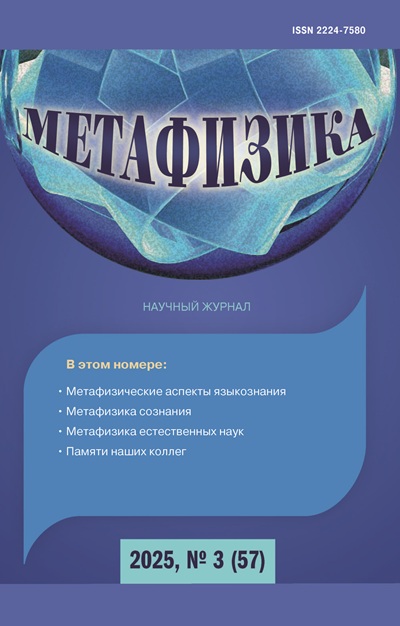
No 3 (2025)

EDITORIAL NOTE

ЕDIТОRIАL NОТЕ

Vladimirov Y.S.
Metaphysics. 2025;(3):6-7
pages 6-7 views

METAPHYSICAL ASPECTS OF LINGUISTICS

SACRED MEANINGS AS A PULSING METAPHYSICAL ESSENCE

Maslova V.A.

Abstract

The article is devoted to sacred meanings as metaphysical entities. The article purpose is to show that the path to revealing the meanings secrets of language and text is the metaphysical doctrine of deep knowledge in the word. This knowledge allows one to look into the fundamentals of being and helps to form a national-cultural religious personality.
Metaphysics. 2025;(3):8-16
pages 8-16 views

DOES LANGUAGE HAVE ITS OWN SECRET?

Vladimirova T.E.

Abstract

The focus of this article is the search for an answer to the eternal question about the secret of the origin of language, which involves examining its deep layers, as well as culture and metaphysical reality. This required turning, on the one hand, to the methodology of studying primitive consciousness, thinking and worldview, and on the other, to the patristic tradition, which had a huge influence on the formation of culture and the Russian linguistic personality. Particular attention in the work is given to the latest research, which brings us closer to solving this centuries-old mystery. The undertaken study of the sacred, historical, cultural and spiritual context of the evolution of language and metaphysical reality based on the data of anthropology, ethnography, archeology, paleopsychology, paleocultural studies, linguogenetics and theolinguistics leads to the conclusion about the fruitfulness of the beginning of the transition from the anthropocentric to the theoanthropocosmic paradigm, which restores the integrity of the spiritual reality inherited with the Russian language and culture.
Metaphysics. 2025;(3):17-29
pages 17-29 views

METAPHYSICAL FOUNDATIONS OF THE STRUCTURE OF THE LANGUAGES OF THE PEOPLES OF THE WORLD

Kinsbursky A.V.

Abstract

The article explores the fundamental primary metaphysical codes that define the forms of activity of social and individual consciousness, including the syntactic and semantic structures of the languages of the world. An attempt is made to demonstrate the connection between the a priori axiomatically chosen metaphysical approach (method) and the typological characteristics of the language of its expression (logos), which together constitute a methodology for understanding the whole that shapes the worldview of a linguistic community or individual.
Metaphysics. 2025;(3):30-45
pages 30-45 views

INFINITIVE AS A SPECIAL GRAMMATICAL CATEGORY IN LANGUAGES OF DIFFERENT SYSTEMS

Tarlanov Z.K.

Abstract

The inconsistency of its grammatical nature in different languages is established by means of the testimony of the data of Indo-European (Slavic and Romano-German) and Caucasian (Dagestan) languages. They prove that in modern languages it is represented at different stages of its change from the named space to the verb, combining some signs of the personalized and verb classes of words. It is stated that the infinitive is not an obligatory element in the grammatical system of a language: with no infinitive at all. It is suggested that in the Romano-Germanic languages the infinitive retains its nominal nature, neutral with respect to modality. Russian linguists consider the infinitive to be one of the most important ways of expressing modality, and therefore it has been rightly called the indefinite mood in Russian linguistics. In the Caucasian languages, the same form is also incorporated into the verbal system, but not as a modal means. Like every significant language category, the infinitive is not indifferent to the realization of ethnic mentality.
Metaphysics. 2025;(3):46-52
pages 46-52 views

METAPHYSICS OF CONSCIOUSNESS

MYSTICAL-THEOLOGICAL TEACHING ABOUT MAN IN THE ORTHODOX SPIRITUAL TRADITION: BIBLICAL SOURCES AND FOUNDATIONS

Postovalova V.I.

Abstract

The article is devoted to the analytical consideration of mystical-theological views on the essence of man in the Orthodox Christian worldview, developing the biblical idea of man as the image and likeness of God and as a microtheos (small god), or god by grace. The specificity of this direction is the transcendental-religious holistic approach, in which man is studied not autonomously, in his self-sufficient being, but in the aspect of his belonging to the anthropocosmic and, ultimately, theoanthropocosmic reality. The most important feature of this teaching is its apophatic nature, associated with the fact that biblical ideas-mythologemes related to Divine Revelation and mystical spiritual experience are not fully amenable to conceptualization and in their depths remain an incomprehensible mystery for rational thought, surpassing any human reason. According to one of the maxims of the Orthodox doctrine, summing up this understanding: “Man is a mysterious cryptogram that no one will ever be able to fully decipher and satisfactorily read” (Archimandrite Cyprian Kern).
Metaphysics. 2025;(3):53-76
pages 53-76 views

THE PROBLEM OF THE TEMPORALITY OF CONSCIOUSNESS IN PHILOSOPHICAL PSYCHOPATHOLOGY

Zhuravleva J.V.

Abstract

The article addresses the problem of the temporality of consciousness in the context of philosophical psychopathology and the temporal metaphor of subjectivity (the metaphor of effort). The possibility of constructing a metamodel of temporality based on retention, cinematographic, and extensional models is discussed. Special attention is given to the idea of the intentional arc, which underlies contemporary phenomenological models of mental pathology. The article shows how an analysis of disruptions in the temporality of consciousness in mental disorders can lead to key issues in philosophical anthropology.
Metaphysics. 2025;(3):77-87
pages 77-87 views

THE NOOSPHERE AND ITS METAPHYSICAL COMPONENT

Sidorov G.N., Sidorova D.G.

Abstract

Over the centuries, people have found out that environmental protection is the most important element of human existence. The study of the fundamental principles of sustainable development has led humanity to the conclusion that it does not correspond to the postulated sustainable development and does not contribute to positive changes in society. This change in the surrounding world was called the noosphere, it was intended to orient man from the destruction of nature to its preservation. The introduction of noospheric principles of human existence into the development of society implied both moral and ethical improvement of human nature, and bringing it into unity with the natural laws of biology and ecology. This did not happen and only within the framework of the natural laws of the universe, without involving a metaphysical view of the world, it is unlikely that it will happen.
Metaphysics. 2025;(3):88-97
pages 88-97 views

NOVUM VERBUM. WHAT LANGUAGE DOES FUTUR-HISTORY SPEAK?

Neklessa A.I.

Abstract

The article is devoted to the methodological aspects of the study of social evolution, attention is paid to the development of methods for the analysis/forecast of complex anthropogenic situations, the dynamics of the scientific apparatus, transdisciplinary transfer and the development of cognitive tools. We are used to dealing with the experience of past situations, packaged in an educational narrative and technological practice. However, the complication of the anthropo-cosmos, its globalization, diversification, and other forms of reorganization stimulate the transformation of the knowledge environment. Humanity, passing through the bottleneck of civilizational transit and mastering opportunities, forms a social space where the activity of individuals, groups and communities increases dramatically, multiplying the wealth of available alternatives.

Metaphysics. 2025;(3):98-105
pages 98-105 views

METAPHYSICS OF NATURAL SCIENCES

METAPHYSICAL PRINCIPLES AND PROGRAMS OF SCIENCE DEVELOPMENT

Yakovlev V.A.

Abstract

The article provides a comparative analysis of the principle of dialectical contradiction, antinomy, qualitative dialectics, binary, resonance. There are seven binary complementary natural philosophical programs of Antiquity. The history of binary research programs in science is traced. The fundamental difference between empiricism and rationalism both in history and at the present stage of development of science on the problem of entities that do not have observable empirical correlates is revealed. A system of general principles that unite modern realism and constructive empiricism is proposed for consideration.
Metaphysics. 2025;(3):106-118
pages 106-118 views

MATHEMATICS AND METAPHYSICS OF INFINITY

Vekshenov S.A.

Abstract

In modern theoretical constructions, one can trace the interaction of two key abstractions: a geometric (material) point and a certain integrity, the ideological source of which are the monads of G.V. Leibniz. The idea of a point, dating back to Euclidean geometry, received a fundamental impetus in set theory due to the introduction of actual (completed) infinity. On the other hand, A. Aspect’s experiments convincingly showed that point objects cannot exist at the fundamental level. Thus, integral monads become the main abstraction of the quantum level of matter. As in the case of a material point, further development of this approach requires a defining ideological impulse, which can only be given by actual infinity. This is already a different, ordinal infinity, fundamentally different from the set-theoretic, quantitative infinity. A number of the author's works are devoted to the development of this approach. This article is, in essence, a brief summary of these works, in which the initial provisions and main results are formulated, without discussing particular issues and consequences.
Metaphysics. 2025;(3):119-145
pages 119-145 views

A PRIORI AND FREQUENCY APPROACHES TO DETERMINING THE CONCEPT OF PROBABILITY

Mikhailov K.A.

Abstract

Two main approaches to understanding probability are considered, their disadvantages and positive sides, and the absence of contradictory results is explained. The application of frequency and a priori approaches in practice, existing alternatives, their difficulties and solutions are discussed.
Metaphysics. 2025;(3):146-158
pages 146-158 views

IRREVERSIBLE RELATIONAL STATISTICAL TIME AND THERMODYNAMICS

Aristov V.V.

Abstract

The paper considers the formalization of time irreversibility within the framework of the generally accepted relational statistical concept. For this purpose, the important role of the notion of a moment in time, constructively limited through a set of radius vectors of the elements of the system under study, is revealed. Comparison of three successive moments in time can give an idea of the irreversibility of the specified vector time. By comparing the intervals of vector time and scalar time determined by the analog of a clock, the justification shows their accuracy, which underlies the definition of a quantitative expression for the entropy of time and the receipt of thermodynamic relations.
Metaphysics. 2025;(3):159-167
pages 159-167 views

IN MEMORY OF OUR COLLEAGUES

IN MEMORY OF D.D. IVANENKO AND YU.G. SBYTOV, AND MY DEVELOPMENT IN SCIENCE

Panov V.F.

Abstract

The article is dedicated to the memory of Professor D.D. Ivanenko and Yu.G. Sbytov. The author recalls his development in theoretical physics and the assistance provided by D.D. Ivanenko and Yu.G. Sbytov in writing his PhD and doctoral dissertations.
Metaphysics. 2025;(3):168-171
pages 168-171 views